
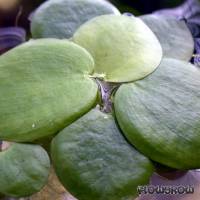
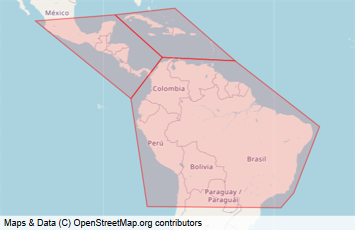
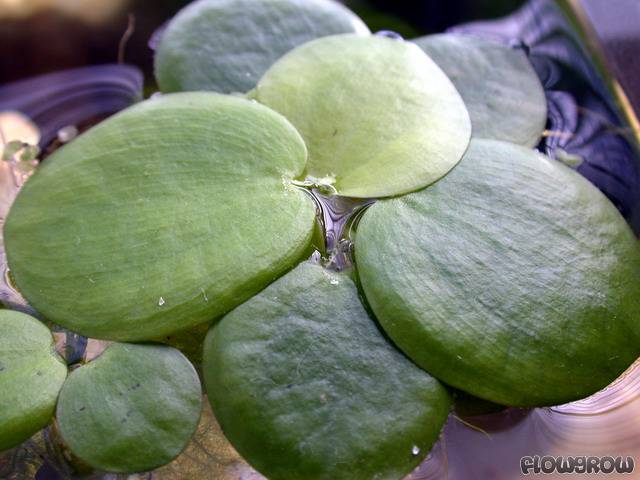
Limnobium laevigatum, Amazon frogbit, is a floating plant that looks a bit like a very large duckweed. It is native to lakes, ponds and slow-flowing rivers in all of Central and South America.
Compared with the North American frogbit species Limnobium spongia, which is only rarely cultivated in aquaria these days, it is much more adaptable especially regarding temperature. Common frogbit (Hydrocharis morsus-ranae), native to Europe and Western Asia, is hardy and thus a great pond plant. It hibernatives in the form of winter buds (turions), and, other than Limnobium laevigatum, it is possibly not apt to live in a tropical tank in the long run.
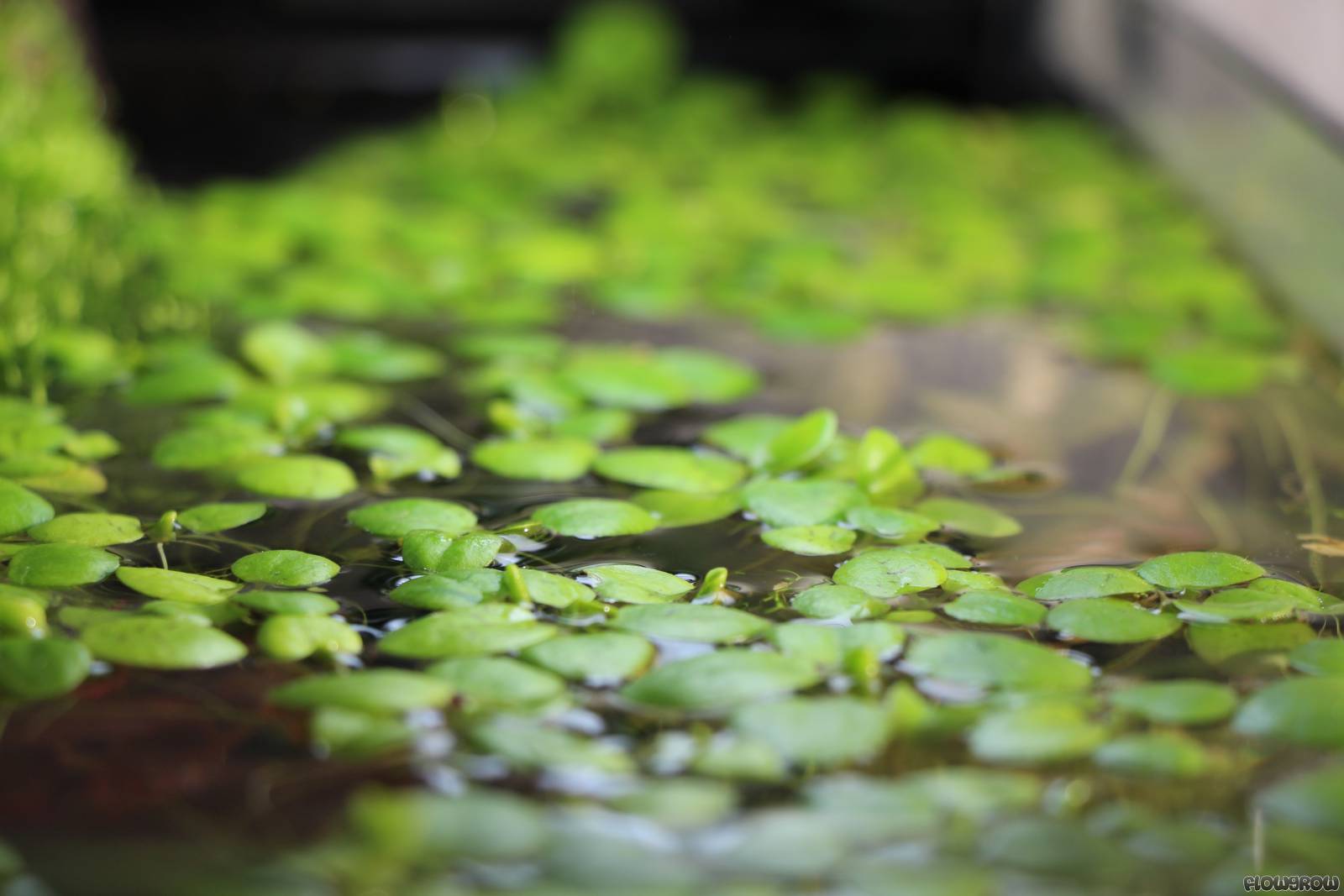
The growth habit of the Amazon frogbit is comparable to other floating plants. The floating rosette forms runners regularly, at whose ends young plants grow. In calm-water zones of the aquarium, carpets of these plants will form after a relatively short time, which may lead to uncalled-for shading of the ground.
Under strong light, with good fertilisation and high air humidity, emersed leaves may form above the waterline. CO2 injection furthers growth. This plant may even flower in the aquarium, although rarely.
Propagation happens automatically. Under optimal conditions you will have a large quantity of frogbit very soon in your tank.
Many people don't see how floating plants help an aquarium layout, as they create shaded areas and grow very long vertical roots. However, just these aspects can be integrated into a design. The play of shade and light can create interesting contrasts in a layout, and the elegant-looking roots may have a very decorative effect.
The growth habit of the Amazon frogbit is comparable to that of other floating plants. The floating rosette regularly produces runners, at the ends of which new young plants form. In calm zones of the aquarium an entire carpet of this plant can therefore quickly develop, which leads to unsightly shading of the substrate.
Under strong light, good fertilisation and high humidity, emersed leaves can form above the water. Flowering in the aquarium is rather rare.
Propagation of this species happens by itself. Under optimal conditions you will quickly have a great deal of Limnobium laevigatum in the aquarium.
(For more see “Design”)
References and further reading:Many people see no use for floating plants in aquascaping, as they create shaded areas in the aquarium and form long roots in the aquarium. However, it is precisely these aspects that can also be effectively incorporated into a design. The interplay of shade and light allows interesting contrasts to be developed in the aquarium. The elegant roots can moreover be used quite decoratively.
References and further reading:<a href="https://www.flowgrow.de/db/aquaticplants/limnobium-laevigatum" target="_blank"><img alt="Limnobium laevigatum" title="Limnobium laevigatum" src="https://www.flowgrow.de/db/widget/aquaticplants/limnobium-laevigatum" /></a>
[url=https://www.flowgrow.de/db/aquaticplants/limnobium-laevigatum][img]https://www.flowgrow.de/db/widget/aquaticplants/limnobium-laevigatum[/img][/url]
[widget=aquaticplants/limnobium-laevigatum]Limnobium laevigatum[/widget]