
Bei dieser Pflanze / Wasserpflanze ist noch nicht geklärt, ob sie sich von einer Pflanze, die schon unter anderem Namen bekannt ist, unterscheidet oder mit dieser identisch ist. Wir haben die Pflanze dennoch in unserer Datenbank gelistet, da sie bereits unter dem hier angegebenen Namen im Aquarienhobby und/oder im Handel bekannt ist. Spätere Änderungen sind nicht ausgeschlossen.
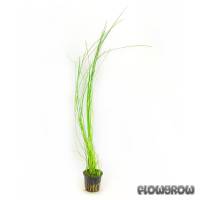
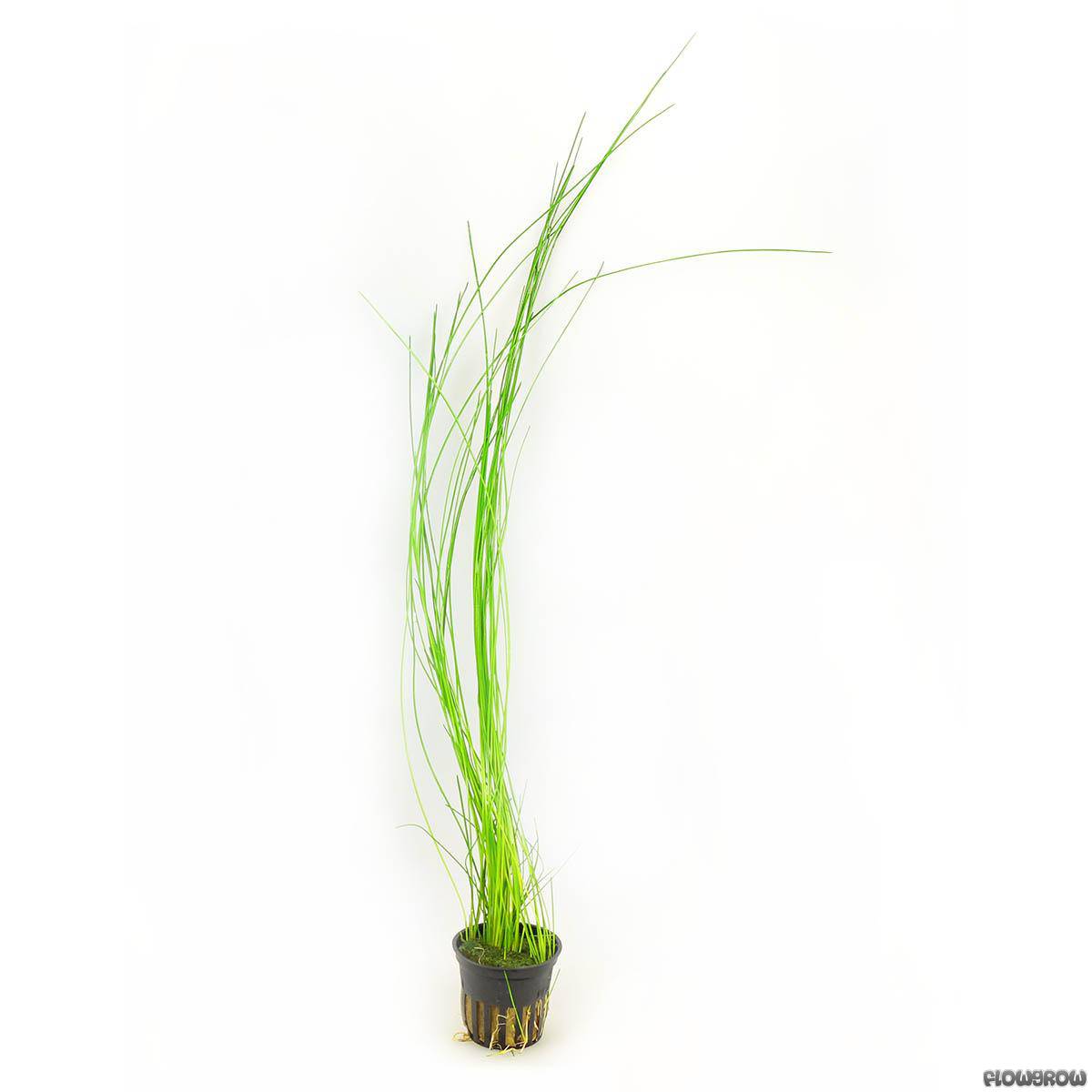
A spike-rush species with long culms is available in the trade under the name Eleocharis montevidensis. It is known mainly in the USA, but has also been offered by the company Tropica (Denmark) since 2013. Whether it really belongs to the species E. montevidensis is not yet certain, so it is provisionally called Eleocharis sp. "montevidensis" here. It might be identical to the as yet unidentified Eleocharis sp. "Xingú". Like this one, E. sp. "montevidensis" has smooth culms more than 50 cm long and approx. 1 mm wide, with an elliptical cross-section. Eleocharis species are often difficult to identify, among other reasons because of the large number of species. Identification is only possible if the plants have spikelets with ripe seeds, which develop at the culm tips in the emersed form.
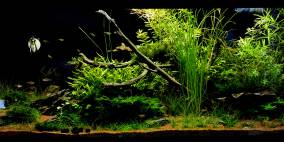
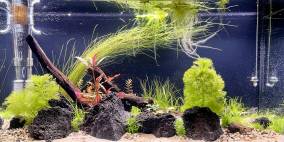
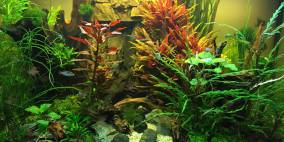
Eleocharis sp. "montevidensis" presumably has the same cultivation requirements as E. sp. "Xingú". The same applies to both plants when they are used in aquascaping.
The true Eleocharis montevidensis is distributed in the central and southern USA, Mexico and South America. The following information is taken from the "Flora of North America" (online version, efloras.org): the species is perennial and forms mats. The rhizomes are long, 0.7 to 2 mm thick, firm, with a persistent cortex; the longer internodes are 1 to 2 cm long. The culms are 5 to 50 cm long and 0.5 to 1.2 mm wide, firm to hard, spongy. The culm cross-section is round to elliptical or four-sided, with 5 to 10 blunt ridges when the culm is dried. The spikelets at the culm tips are 4-12 mm long and (1.5-)2-3 mm wide, with a rounded to pointed tip. E. montevidensis grows in wet soil, ponds, lakes, streams, springs, swamps, ditches and grassland at an elevation of 0 to 2300 m above sea level.1
The "Flora of North America" gives no indication of whether E. montevidensis also grows submersed in nature. The species is described as extremely variable and is apparently closely related to Eleocharis parishii. Typical characteristics of E. montevidensis are broadly rounded, mostly wrinkled and recurved floral scales in the spikelets. Nutlets often do not develop in these.1
<a href="https://www.flowgrow.de/db/aquaticplants/eleocharis-sp-montevidensis" target="_blank"><img alt="Eleocharis sp. "montevidensis"" title="Eleocharis sp. "montevidensis"" src="https://www.flowgrow.de/db/widget/aquaticplants/eleocharis-sp-montevidensis" /></a>
[url=https://www.flowgrow.de/db/aquaticplants/eleocharis-sp-montevidensis][img]https://www.flowgrow.de/db/widget/aquaticplants/eleocharis-sp-montevidensis[/img][/url]
[widget=aquaticplants/eleocharis-sp-montevidensis]Eleocharis sp. "montevidensis"[/widget]