


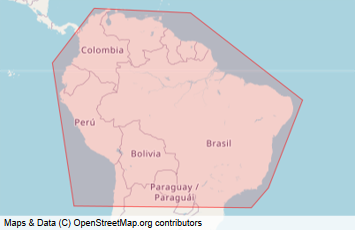
 Range and localities [?]:
Brazil: Mato Grosso, Rio Aripuanã


Echinodorus inpai is a medium-sized sword plant that has so far only been found on the Rio Aripuanã in the north of Mato Grosso (Brazil). It was described as a species by Karel Rataj in 1981. The species name refers to the Brazilian state research institute INPA (Instituto Nacional de Pesquisas da Amazônia).
E. inpai has been in cultivation since 1987 and occasionally comes onto the market, but is probably little known in the aquarium hobby. According to the experience of Christel Kasselmann (2001), this species does not grow well in the aquarium.
The INPA sword plant is very similar to the winged sword plant (Echinodorus subalatus), which is widespread in Central and South America. According to Haynes & Holm-Nielsen (1994), the species status of E. inpai is uncertain, and the plant possibly belongs to E. subalatus. Lehtonen (2008) accepts it with reservations as a separate species.
Echinodorus inpai is closely related not only to E. subalatus, but also to E. palaefolius and E. decumbens. These four species have in common a characteristically longitudinally grooved petiole that is channelled on the upper side, and relatively small flowers with 12 stamens. E. inpai differs from E. subalatus among other things in the profile of the inflorescence axis between the whorls: it is three-angled in both species, but in E. subalatus the angles are winged (alate) and in E. inpai not winged. E. inpai has translucent markings (laticifer canals) in the leaves in the form of lines that are longer than in E. subalatus.
The leaves have petioles up to 60 cm long, the leaf blades are narrowly lanceolate and 6-25 cm long and 3-9 cm wide. The inflorescences are upright and do not overtop the leaf rosette. The flowers are almost sessile (very shortly stalked) and have a diameter of 0.8-1.2 cm. The white petals do not overlap one another. The fruits are spherical aggregate fruits with many nutlets that have a gland on both sides and a long beak. Adventitious plantlets develop on the inflorescence.
(For more, see “Culture” and “Design”)
As mentioned under "General", Echinodorus inpai is poorly suited as an aquarium plant according to the experience of Kasselmann (2001).
As an emersed plant, however, the species grows well and has the same requirements as many other Echinodorus species: medium to high light intensity, abundant macronutrient supply via the soil (or via nutrient solution in hydroponics) and temperatures above 20 °C. It grows excellently, e.g. on wet loamy soil under greenhouse conditions. Perhaps E. inpai would be well suited as a semi-emersed plant in open tanks with a low water level or as a marsh plant in large paludariums. Like other Echinodorus species, E. inpai in its land form is easily attacked by various pests such as aphids and mealybugs.
The inflorescences appear on the emersed plant and produce abundant adventitious plantlets. Over time the plant also forms daughter rosettes at the base. This produces a multi-headed clump, which can be divided with a spade or knife for propagation.
We are not aware of any aquascaping examples with Echinodorus inpai. Because, as mentioned under "General", this sword plant grows poorly in the aquarium, it can probably be recommended rather as a marsh plant for emersed layouts such as open tanks or large paludariums and ripariums.
With its lanceolate, medium green leaves and relatively small flowers, the INPA sword plant has a rather plain appearance. It probably makes hardly any difference whether one uses E. inpai or E. subalatus for emersed layouts, because the two species look very similar. The latter species, however, grows well as a submersed aquarium plant.
<a href="https://www.flowgrow.de/db/aquaticplants/echinodorus-inpai" target="_blank"><img alt="Echinodorus inpai" title="Echinodorus inpai" src="https://www.flowgrow.de/db/widget/aquaticplants/echinodorus-inpai" /></a>
[url=https://www.flowgrow.de/db/aquaticplants/echinodorus-inpai][img]https://www.flowgrow.de/db/widget/aquaticplants/echinodorus-inpai[/img][/url]
[widget=aquaticplants/echinodorus-inpai]Echinodorus inpai[/widget]
