


The name Riccia rhenana is well known among aquarists, but is probably used incorrectly.
In the aquarium hobby and trade, R. rhenana usually means a Riccia that does not float at the surface like “normal” R. fluitans, but sinks, grows submersed and is often rather dark green. For example, in the Mergus Aquarienatlas volume 3, 1st edition (1990), R. rhenana is listed as “Absinkendes Teichlebermoos” (sinking pond liverwort).
In our opinion, however, this “sinking pond liverwort” does not belong to Riccia rhenana.
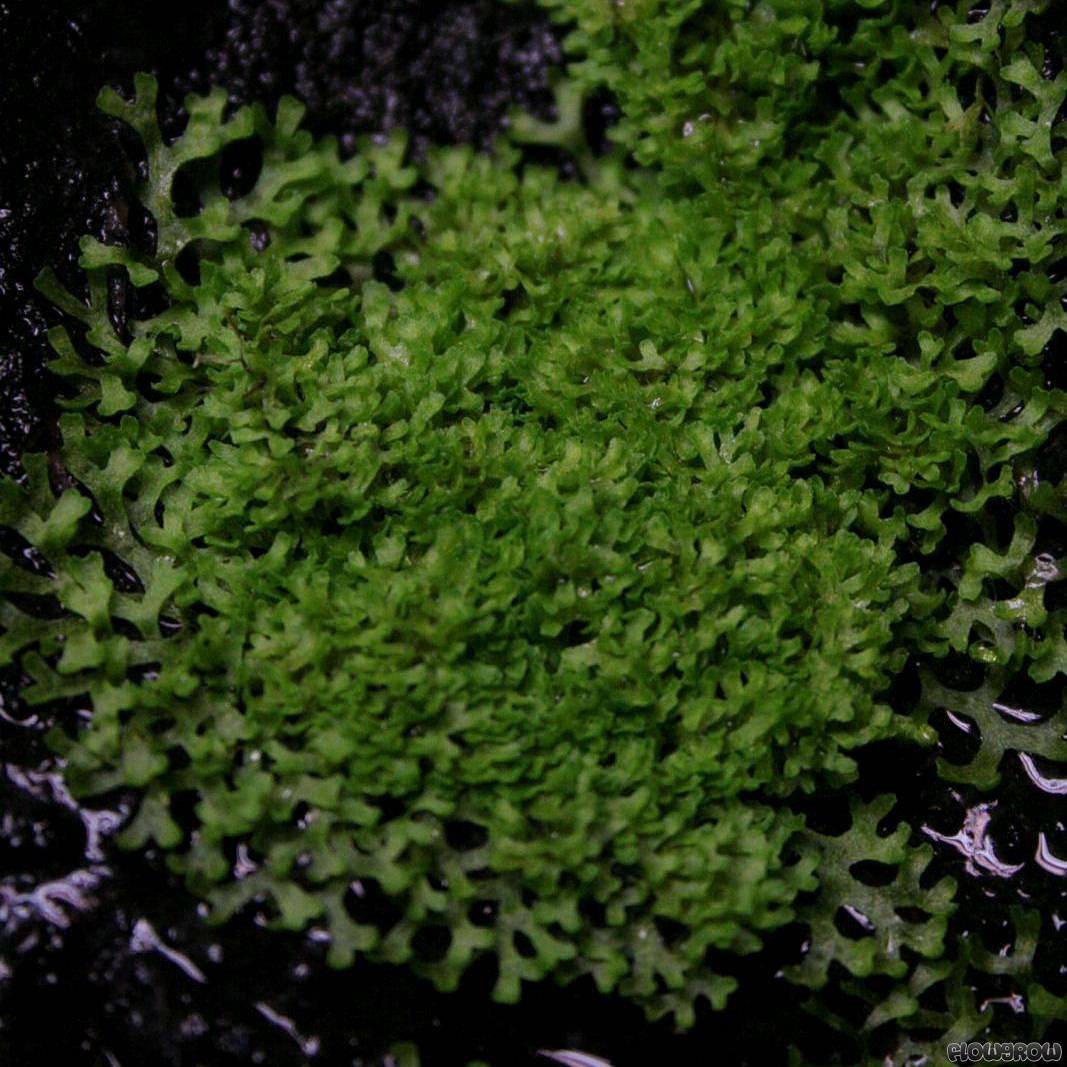
According to the descriptions in botanical literature, underwater growth is by no means a distinguishing feature between Riccia rhenana and R. fluitans. What matters instead are the characteristics of the land form, which develops when the liverwort grows on wet substrate. Riccia rhenana accordingly forms wider thalli than R. fluitans (up to 2.8 mm), the forked branches are fairly short in relation to their width, and the angle of forking is rather obtuse (> 90°). In the land form of R. fluitans, by contrast, the thalli are narrower (up to 1.5 (1.8) mm), and the forking angle is rather acute (< 90°). In the floating and submersed forms the two species cannot be reliably distinguished by appearance. The chromosome number of R. rhenana is given as twice as high (n = 16) as that of R. fluitans (n = 8). However, there is no strict correlation between the chromosome number and the morphological characters by which the two species have traditionally been distinguished. Experts disagree on whether Riccia rhenana should be regarded as a distinct species or included in R. fluitans.
In aquarium cultivation there are different plants from the Riccia fluitans complex that have been introduced from various countries. All of them can grow both floating and on the aquarium bottom, but some of them tend to sink more readily than others under the same cultivation conditions. In particular a “form from Japan” is especially well suited to underwater cultivation (see Tropica website []). This form may be identical to the liverwort that is called “Riccia rhenana” in the aquarium hobby. However, in its emersed form this Japanese Riccia has very elongated thallus branches and thus does not match the descriptions of R. rhenana in bryophyte identification literature. It also differs from “typical” R. fluitans, which occurs wild in Central Europe.
Riccia shoots are dark green and transparent when no air-filled chambers are formed in the thallus tissue. On such underwater shoots, however, light green, non-translucent thalli containing air chambers can develop spontaneously. The colouring can therefore not be used to distinguish species or forms from the Riccia fluitans complex.
Presumably “true” Riccia rhenana is also kept in aquariums. But it is quite possible that it is not recognised as such, but mistaken for “normal” pond liverwort (R. fluitans in the narrow sense).
<a href="https://www.flowgrow.de/db/aquaticplants/riccia-rhenana" target="_blank"><img alt="Riccia rhenana" title="Riccia rhenana" src="https://www.flowgrow.de/db/widget/aquaticplants/riccia-rhenana" /></a>
[url=https://www.flowgrow.de/db/aquaticplants/riccia-rhenana][img]https://www.flowgrow.de/db/widget/aquaticplants/riccia-rhenana[/img][/url]
[widget=aquaticplants/riccia-rhenana]Riccia rhenana[/widget]