

Under the names "Perlenmoos" and "Perlmoos" (pearl moss), several mosses with rounded leaflets are known in the aquarium hobby. Looked at closely, they are quite different mosses. In some cases they are foliose (= leafy) liverworts; two species have been identified as Heteroscyphus zollingeri and Solenostoma tetragonum. But "pearl moss" can also refer to mosses of the genus Plagiomnium (creeping star moss).1
Plagiomnium species have leaves with a distinct midrib that runs to the leaf tip or ends just before it. This alone distinguishes them from foliose liverworts, which never have a leaf midrib. The shoots (in the terrestrial form) often grow arching and overhanging or creeping; this is, among other things, how Plagiomnium species differ from the very similar genus Mnium (star moss).
The creeping star mosses are sometimes labelled in the trade as Plagiomnium affinis (correct spelling: Plagiomnium affine). They do indeed look similar to the species P. affine, but it is not certain whether they belong to this species. The aquarium moss is therefore provisionally called Plagiomnium cf. affine here.
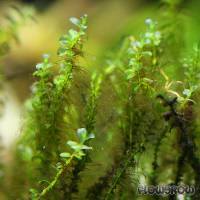
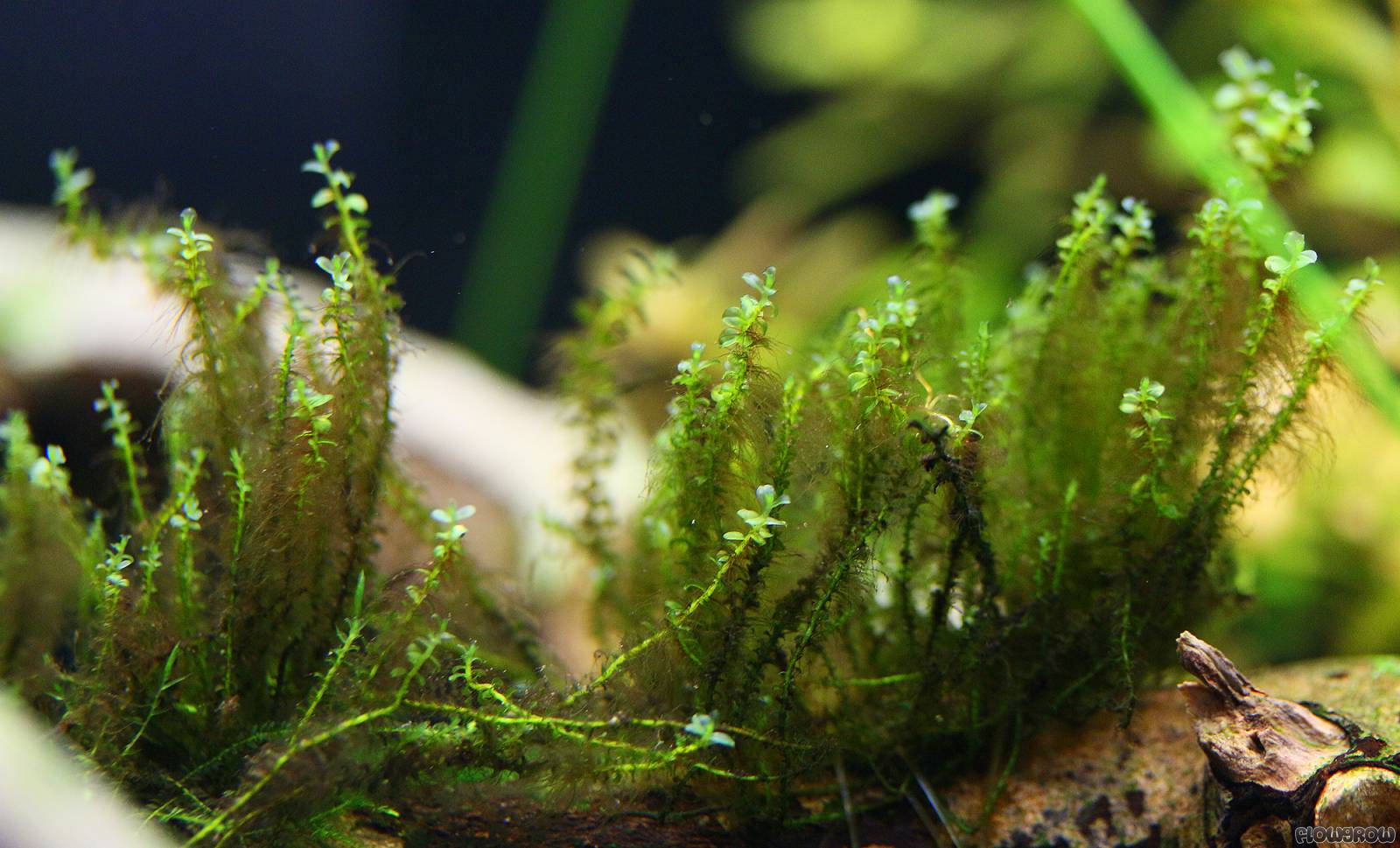
At least one of the Plagiomnium forms from the trade is suitable as an aquarium moss. Under water the shoots grow upright and often form a dense reddish-brown felt of rhizoids (hair-like attachment organs) on the older parts of the stem. This Plagiomnium cf. affine grows very slowly submersed; medium to high light intensity, a good nutrient supply and CO2 fertilisation are recommended.
The true Plagiomnium affine is frequently found in Central Europe on moist, nutrient-rich forest floors, on shady banks, path edges etc. However, there are a number of similar Plagiomnium species worldwide which, like practically all mosses, can only be identified reliably on the basis of microscopic characteristics. Among the Plagiomnium species native to Germany, for example, there are three (Plagiomnium elatum, P. ellipticum, P. medium) that look very similar to P. affine and are grouped with this species into a species group (Plagiomnium affine agg.).
- To be continued -
<a href="https://www.flowgrow.de/db/aquaticplants/plagiomnium-cf-affine" target="_blank"><img alt="Plagiomnium cf. affine" title="Plagiomnium cf. affine" src="https://www.flowgrow.de/db/widget/aquaticplants/plagiomnium-cf-affine" /></a>
[url=https://www.flowgrow.de/db/aquaticplants/plagiomnium-cf-affine][img]https://www.flowgrow.de/db/widget/aquaticplants/plagiomnium-cf-affine[/img][/url]
[widget=aquaticplants/plagiomnium-cf-affine]Plagiomnium cf. affine[/widget]