 Range and localities [?]:
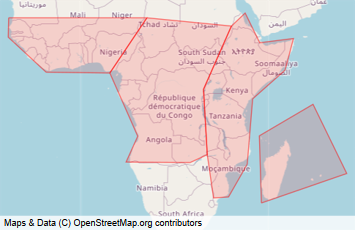
Tropical Africa, Madagascar

Plagiochila integerrima is a relatively large, robust foliose (= leafy) liverwort that is widespread in tropical Africa and the Madagascan island region in moist places. It grows, e.g., at the edges of forest streams. It looks similar to many other Plagiochila ("slant-mouth moss") species, e.g. the species native to Central Europe, P. asplenioides and P. porelloides, which likewise colonise moist, shady places. The genus Plagiochila contains over 500 species and is widespread, especially in the tropical regions of the world.
Plagiochila integerrima forms irregularly and relatively sparsely branched shoots that grow horizontally to ascending and reach a length of 10 cm and more. With its rounded leaves arranged in two rows (lateral leaves), this moss is reminiscent of the "pearl moss" Heteroscyphus zollingeri, which, however, is distinctly more delicate, softer, smaller-leaved and lighter green and comes from Asia. In addition, Heteroscyphus has tiny underleaves (amphigastria) on the underside of the shoot, which are absent in P. integerrima. The leaves of P. integerrima look entire-margined when viewed with the naked eye. Under magnification, many small teeth can be seen on the leaf margin. The leaves are dark to medium green and translucent. Young side shoots are at first distinctly narrower and smaller-leaved than the main shoots.
Although Plagiochila integerrima is not expressly described as an aquatic moss in the botanical literature, experience so far shows that this liverwort can be cultivated very well under water. According to information from Maike Wilstermann-Hildebrand, the aquarium population comes from Guinea in West Africa. The moss was found at the former Gula aquatic plant nursery (Remseck near Stuttgart) on rhizomes of Anubias gracilis that had been imported from Guinea. P. integerrima has been in aquarium cultivation since about 2007, but at present (early 2014) probably still remains a hardly known rarity.
An unidentified liverwort also circulates in the hobby as a moss rarity under the name Plagiochila sp. "Cameroon", also under the Japanese name Hanegoke sp. "Cameroon". In photos it looks like the plant from Guinea and could likewise be Plagiochila integerrima; this species, which is widespread in Africa, has also been recorded from Cameroon.
(For more see "Culture" and "Design")
Plagiochila integerrima apparently grows well in water with low to medium carbonate hardness, is greatly promoted by CO2 addition and seems to grow better under rather weak to medium lighting than under intense light. A good (macro-)nutrient supply is apparently important for this liverwort. Nutrient deficiency shows as increasingly narrower, paler shoots.
It remains to be tested how well this liverwort attaches itself to hard substrates. Tying it onto rock or wood is, however, highly recommended. This leafy liverwort looks best when it has developed undisturbed in a fixed place and the position of the shoots has not been changed.
Plagiochila integerrima grows quite slowly submersed, even in comparison with many other mosses, and can therefore quickly become overgrown with algae. This moss should only be used in tanks with little algae.
Emersed, P. integerrima can be cultivated well on moist to wet substrate at very high humidity. The leaves dry out very quickly in air that is too dry.
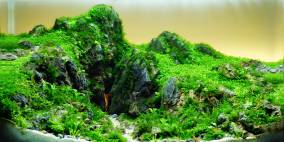
References and further reading:Plagiochila integerrima is still very rare and hard to obtain in the aquarium hobby; accordingly, there are practically no known examples yet of its use in aquascaping. For a moss, P. integerrima looks quite unusual. The densely and regularly leaved, relatively large shoots are slightly reminiscent of narrow fern fronds. This liverwort from the tropical African home range of Anubias and Bolbitis heudelotii may fit well into natural-looking layouts with these epiphytes.
References and further reading:<a href="https://www.flowgrow.de/db/aquaticplants/plagiochila-integerrima" target="_blank"><img alt="Plagiochila integerrima" title="Plagiochila integerrima" src="https://www.flowgrow.de/db/widget/aquaticplants/plagiochila-integerrima" /></a>
[url=https://www.flowgrow.de/db/aquaticplants/plagiochila-integerrima][img]https://www.flowgrow.de/db/widget/aquaticplants/plagiochila-integerrima[/img][/url]
[widget=aquaticplants/plagiochila-integerrima]Plagiochila integerrima[/widget]