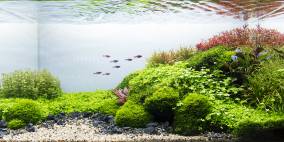
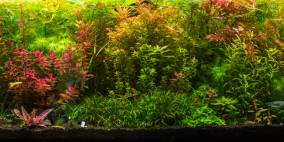
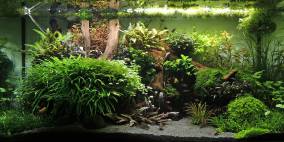
This moss appeared in Berlin in about 2007 as a nameless aquarium moss. We do not know where it was originally collected. Because of its microscopic characteristics it certainly belongs to the moss family Pilotrichaceae and presumably to the genus Cyclodictyon. This genus includes many predominantly tropical or subtropical moss species that mostly colonise moist to wet places such as stream banks and waterfalls. As long as this aquarium moss has not been identified more precisely, it is referred to here by the family name (Pilotrichaceae). The company Aquasabi has carried the moss since 2014 under the common name "Pilo moss".
Pilotrichaceae sp. develops strongly flattened, almost distichously leaved shoots that branch irregularly in a pinnate manner and, under water in strong light, grow more or less hanging down, similar to "Weeping moss" (Vesicularia ferriei). In low light the shoots grow more horizontally. On flat surfaces they form a creeping, flat, dense mat. The "Pilo moss" has a strong, rather dark shade of green. It attaches itself reliably to hard substrates (driftwood, stones) with its rhizoids, which unfortunately is not the case with Vesicularia ferriei.
At first glance one could take Pilotrichaceae sp. for a Vesicularia species, but when viewed under a microscope distinct differences become apparent that point to the genus Cyclodictyon: it has approximately tongue-shaped, shortly pointed leaves, often somewhat bent sideways, with a long double costa (two long ribs that reach close to the leaf tip), relatively large, wide, thin-walled leaf cells and a leaf border of narrower cells. The genus Callicostella, which has already become known in the hobby, belongs to the same family.
This moss from a group of relatives still hardly known to aquarists is apparently undemanding, can be used in many ways in aquascaping and will certainly find wide distribution in the hobby.
- To be continued -
<a href="https://www.flowgrow.de/db/aquaticplants/pilotrichaceae-sp" target="_blank"><img alt="Pilotrichaceae sp." title="Pilotrichaceae sp." src="https://www.flowgrow.de/db/widget/aquaticplants/pilotrichaceae-sp" /></a>
[url=https://www.flowgrow.de/db/aquaticplants/pilotrichaceae-sp][img]https://www.flowgrow.de/db/widget/aquaticplants/pilotrichaceae-sp[/img][/url]
[widget=aquaticplants/pilotrichaceae-sp]Pilotrichaceae sp.[/widget]