


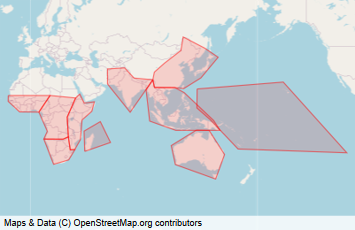
 Range and localities [?]:
Sub-Saharan Africa; subtropical and tropical Asia from Afghanistan and China to Sri Lanka and New Guinea; tropical Australia; New Caledonia1

The name Ludwigia perennis is fairly well known in the aquarium hobby. However, it is used erroneously, because the plants from the trade that are labelled this way belong to Ludwigia glandulosa. This plant was originally introduced in the 1980s as "Ludwigia perennis" and later identified as L. glandulosa. Nevertheless, it is still often sold under the wrong name.
The true Ludwigia perennis is a completely different species. It has probably never been used as an aquarium plant, and we have no information on whether it is suitable for submersed cultivation.
Unlike L. glandulosa, this species does not originate from North America but is distributed in the tropics and subtropics of Africa, Asia and Australia. The wild habitats of L. perennis are wet places such as floodplains and rice fields at altitudes of 0 to 1,200 m above sea level.1 In some areas of Benin (West Africa), the leaves of L. perennis are traditionally gathered as a wild vegetable in the rainy season and are also offered at local markets.2
Ludwigia perennis is an annual, herbaceous plant growing up to 1 m tall. The leaves are narrowly elliptic to lanceolate, 1 to 11 cm long and 0.3 to 2.7 cm wide. The petiole is winged and 2 to 15 mm long. On each side of the leaf midrib there are 6 to 12 main lateral veins.
The flowers have 4, rarely 5 triangular sepals up to 3.5 mm long and up to 1.8 mm wide, and yellow, elliptic petals that are 1-3 mm long and 0.7-2 mm wide. In contrast, Ludwigia glandulosa has flowers without petals. (Detailed description of L. perennis: see reference1)
<a href="https://www.flowgrow.de/db/aquaticplants/ludwigia-perennis" target="_blank"><img alt="Ludwigia perennis" title="Ludwigia perennis" src="https://www.flowgrow.de/db/widget/aquaticplants/ludwigia-perennis" /></a>
[url=https://www.flowgrow.de/db/aquaticplants/ludwigia-perennis][img]https://www.flowgrow.de/db/widget/aquaticplants/ludwigia-perennis[/img][/url]
[widget=aquaticplants/ludwigia-perennis]Ludwigia perennis[/widget]
