Fissidens fontanus, the spring fork-tooth moss (German: “Quell-Gabelzahn”*), also known as Octodiceras fontanum and O. julianum, is a true aquatic moss and grows submersed in rivers and lakes. It is common in North America, but also occurs in Central America, North Africa and the warmer parts of Europe. In Germany it was initially found only in fountain basins in south-western Germany, but has spread strongly since the 1960s and has meanwhile been recorded in almost all larger rivers. Among other places, it occurs in the lower reaches of the Rhine and the Elbe. This moss apparently copes with very small amounts of light, since in the Rhine, for example, it grows on stones below the low-water line and is located at a depth of more than 2 m at medium water levels and more than 4 m at high water. It can be found, among other places, on embankment walls under bridges, where fewer algae grow because of the shade. At the natural sites F. fontanus is often blackish in colour because of diatom growth.
Although this beautiful aquatic moss is widespread and grows very well in aquariums, it became known in the aquarium hobby late, probably in the 1990s. Of all the Fissidens species introduced so far, F. fontanus is the easiest to keep submersed. This species quickly gained popularity and is now frequently used in aquascaping. F. fontanus is imported from Asia as “Phoenix moss”, where it is only cultivated and is not native.
Fissidens fontanus is a delicate, filigree-looking, dark green moss that attaches itself to wood or rock with rhizoids and forms tuft-like or lawn-like stands. Like all Fissidens species it has two-ranked leaves; the small leaves are arranged in one plane along the stem, so that the shoots are reminiscent of palm fronds or feathers. From most other Fissidens species it differs, however, in its soft, limp texture and its very narrow leaves. The sparsely branched shoots can grow to at least 10 cm in length, but mostly remain much shorter. In air F. fontanus dries out quickly. When dried it is very brittle.
There are five further, very similar Fissidens species in Africa, Australia, North America and southern South America which, together with F. fontanus, belong to the subgenus Octodiceras and are likewise true aquatic mosses. They are not yet known as aquarium mosses, but would probably also be suitable as such. The species of the subgenus Octodiceras are distinguished by microscopic details of the leaves and by the position of the spore capsules on the plant.
The species Fissidens fontanus itself is very variable, and different forms of this species are cultivated which differ from one another under the same conditions, above all in size. They are in the trade, for example, as Fissidens spec. and, mistakenly, as “F. nobilis”. (The true Fissidens nobilis is a completely different-looking, much larger and more robust species.)
(For more, see “Culture” and “Design”)
*)The German names Gabelzahn and Spaltzahnmoos are a translation of the Latin name Fissidens (“split tooth”) and refer to the tiny so-called peristome teeth, which sit in the opening of the spore capsules and are split in Fissidens species.
Like other mosses, Fissidens fontanus can be tied onto stones or wood, where it soon attaches itself with its dark brown tufts of rhizoids. It remains permanently attached to the surface and, unlike many other mosses, does not need to be pruned or retied often. New shoots appear in groups, mainly at the base of older shoots, at the point where they are attached to the surface with the rhizoids. This gives rise to the tufted or lawn-like growth of this moss. It is not uncommon for new shoots to appear spontaneously in places where you have not established them.
For propagation, shoots or tufts that have grown long are cut or plucked off and tied on.
This moss makes low demands on the cultivation conditions, is suitable for cold-water and warm-water tanks and can be cultivated well at temperatures between 15 and 28 °C. It copes with little light, but looks best under relatively strong lighting.
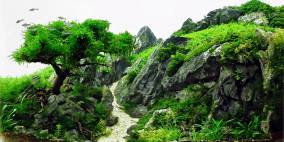
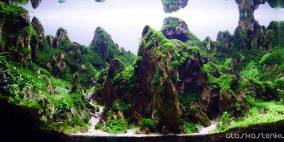
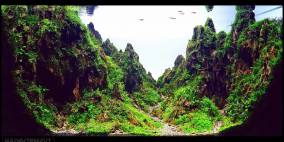
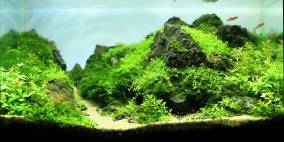
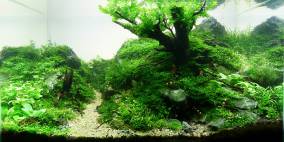
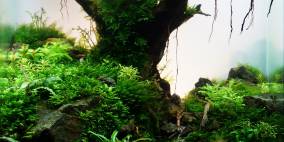
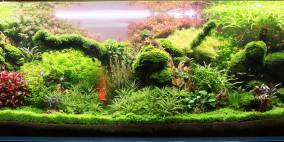
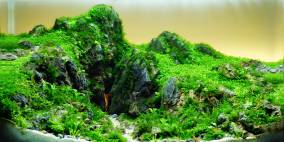
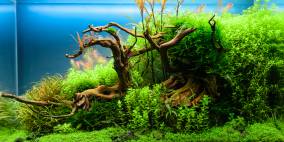
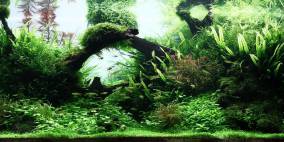
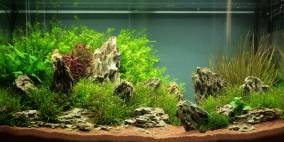
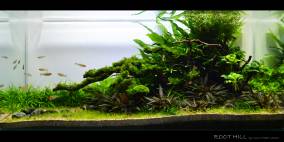
Fissidens fontanus looks particularly decorative when it grows in dense stands on vertical structures or envelops branches and twigs like a green fur. If you want to use it as a lawn-like ground cover, you should tie it onto flat stones or the like.
- To be continued -
<a href="https://www.flowgrow.de/db/aquaticplants/fissidens-fontanus" target="_blank"><img alt="Fissidens fontanus" title="Fissidens fontanus" src="https://www.flowgrow.de/db/widget/aquaticplants/fissidens-fontanus" /></a>
[url=https://www.flowgrow.de/db/aquaticplants/fissidens-fontanus][img]https://www.flowgrow.de/db/widget/aquaticplants/fissidens-fontanus[/img][/url]
[widget=aquaticplants/fissidens-fontanus]Fissidens fontanus[/widget]