


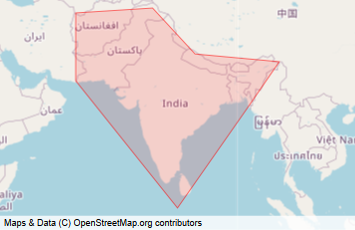
 Range and localities [?]:
Mainly southwest, also southeast and northeast of India


The name Cryptocoryne retrospiralis has long been known in the aquarium hobby and the aquatic plant trade. But the aquarium plants designated in this way are almost never the true C. retrospiralis from India, but Cryptocoryne crispatula var. flaccidifolia from Southeast Asia. There is certainly a historical reason for this: about 50 years ago, various Southeast Asian Cryptocorynes, which today are counted as C. crispatula and C. albida, were regarded as varieties or subspecies of C. retrospiralis.
There is also a long, narrow-leaved plant that came onto the market in the 1970s as “C. retrospiralis”, but which Jan Bastmeijer identified, on the basis of its inflorescences, as a form of Cryptocoryne spiralis var. spiralis. So quite different plants can hide under the name “Cryptocoryne retrospiralis”.
The true Cryptocoryne retrospiralis, which is distributed only in India, on the other hand, is not widespread in the aquarium hobby. It is rarely available commercially and is cultivated by only a few hobbyists. The German name “Gedrehter Wasserkelch” (literally “twisted water chalice”) does not refer to twisted leaves, but to the fact that the bract of the inflorescence (the spathe) is spirally twisted. The plant flowers only in the terrestrial form.
This narrow-leaved Cryptocoryne species is distributed mainly in the area along the west coast of India (in the same area as C. spiralis), but has also been found in the south-east and north-east of the country. The species occurs on riverbanks and in places forms dense, grass-like stands there, which are flooded during the rainy season and grow and flower emersed in the dry season.
Cryptocoryne retrospiralis belongs to the species group around Cryptocoryne crispatula and is particularly similar to the variety C. crispatula var. crispatula. It differs from it only in a few details of the inflorescences. The blade of the bract (spathe) of C. retrospiralis has reddish spots on a yellowish to greenish background on the inside, whereas in C. crispatula lines and spots are more likely to be seen. The spathe blade is tightly spirally twisted, as in C. crispatula.
The underwater leaves and normal emersed leaves of C. retrospiralis are linear, 15 to 40 cm long and 1 to 10 mm wide, with a smooth to slightly wavy margin. In the wild and in daylight culture this species regularly goes through a dormant period, during which it forms short, subulate (pointed and round in cross-section) “winter leaves”. They possibly represent an adaptation to flooding. Such leaves are also known from other plants in the C. crispatula relationship. Bastmeijer (The Crypts Pages) mentions, however, that there may also be clones of C. retrospiralis without a dormant period.
(For more, see “Culture” and “Design”)
The true Cryptocoryne retrospiralis is described, e.g. by Jan Bastmeijer ("The Crypts Pages"), as not well suited to the aquarium because it has a seasonal growth character; growth and resting periods (dormant phase) alternate in this Cryptocoryne. Christel Kasselmann (2010), however, cultivated this species successfully over several years in an aquarium with hard water. It is therefore certainly worth testing C. retrospiralis in the aquarium - if one has the opportunity to obtain this rarely kept species.
C. retrospiralis is easy to cultivate emersed; loamy substrate is recommended. It tolerates full sun at up to 35 °C. Under daylight cultivation it produces normal linear leaves from spring (March/April) until midsummer and grows very fast. After that it develops the short, awl-shaped "winter leaves" mentioned under "General" and enters the dormant phase. During this time it can be kept cool (around 15 °C). New growth in spring is rapid. The inflorescences usually appear during this period.
References and further reading:Because the true Cryptocoryne retrospiralis is evidently hardly cultivated as an aquarium plant and is not commercially available, not much can be said here about its use in aquarium design or aquascaping. The photo of submersed C. retrospiralis in Kasselmann (2010), "Aquarienpflanzen" shows this species as a plant with long, narrow, ribbon-shaped, green, rather smooth leaves in the midground of the aquarium, where it contrasts with red-leaved stem plants and the light green, pinnate-leaved Hygrophila difformis. The possible uses of C. retrospiralis are probably comparable to those of C. crispatula var. flaccidifolia.
References and further reading:<a href="https://www.flowgrow.de/db/aquaticplants/cryptocoryne-retrospiralis" target="_blank"><img alt="Cryptocoryne retrospiralis" title="Cryptocoryne retrospiralis" src="https://www.flowgrow.de/db/widget/aquaticplants/cryptocoryne-retrospiralis" /></a>
[url=https://www.flowgrow.de/db/aquaticplants/cryptocoryne-retrospiralis][img]https://www.flowgrow.de/db/widget/aquaticplants/cryptocoryne-retrospiralis[/img][/url]
[widget=aquaticplants/cryptocoryne-retrospiralis]Cryptocoryne retrospiralis[/widget]

