


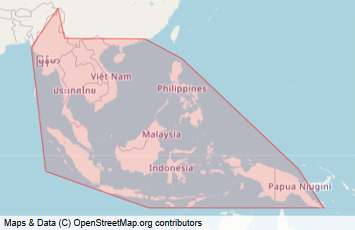
 Range and localities [?]:
Borneo (West and East of Sarawak), southern Malaian peninsula, Sumatra


The long-tailed water trumpet has been found in the north of Borneo, in the south of West Malaysia and on Sumatra. It occurs emersed and submersed in the shallow water of forest streams and rivers and also in irrigation ditches of rubber plantations, where it forms dense stands on muddy or sandy-loamy soil.
In the 1950s and 1960s, plants were known in the aquarium hobby under the name Cryptocoryne longicauda. They later turned out to be a different species, which was described by H.C.D. de Wit in 1970 as Cryptocoryne fusca. The true C. longicauda, discovered in Sarawak by Odoardo Beccari, had already been named in 1879. The species described later, C. caudata from Sarawak and C. johorensis from Johor (Malaysia), have been recognised as synonyms of C. longicauda.
Cryptocoryne longicauda has occasionally come onto the market, but is relatively rarely in cultivation and is mostly kept as an emersed plant by cryptocoryne enthusiasts. It is considered a species suitable for aquariums, which however has special requirements (acidic environment).
The most striking feature of C. longicauda is the unusual shape of the inflorescences. The tip of the spathe ends in a tail up to 20 cm long, after which this water trumpet species is named (longicauda = “long-tailed”). The opened spathe limb is mostly shaped almost like a hemispherical bowl, wrinkled on the inside and mostly dark purple in colour. At the transition to the spathe tube there is a distinct, lighter coloured, irregularly shaped collar zone. During flowering, the tailed spathe limb, which is initially upright, bends forward.
C. longicauda is a variable species; depending on the locality variant, the leaves have a lanceolate to broadly oval shape with a heart-shaped base. The petioles are 5 to 30 cm long, the leaf blades 3 to 15 cm long and 3 to 10 cm wide. The leaf margin has a membranously thin, smooth to finely crinkled border. The leaves are smooth to hammered (bullate) and have olive green to slightly purple colour tones. Emersed plants remain lower, at up to 20 cm in height, than the underwater form (up to 50 cm).
(For more, see “Culture”)
According to relevant literature, Cryptocoryne longicauda thrives at relatively high temperatures above 25 °C, best around 26-28 °C, and weak lighting. For submersed cultivation a pH value of 5 to 6 and soft water (GH 2-5 °dH) are recommended. According to Wilstermann-Hildebrand & Hildebrand (2011), the plant is best placed in a well-matured tank with old mulm in the substrate, or it can also be cultivated in pots with a substrate mixture of 80 % gravel, 10 % loam and 10 % little-rotted beech leaf soil.
- To be continued -
<a href="https://www.flowgrow.de/db/aquaticplants/cryptocoryne-longicauda" target="_blank"><img alt="Cryptocoryne longicauda" title="Cryptocoryne longicauda" src="https://www.flowgrow.de/db/widget/aquaticplants/cryptocoryne-longicauda" /></a>
[url=https://www.flowgrow.de/db/aquaticplants/cryptocoryne-longicauda][img]https://www.flowgrow.de/db/widget/aquaticplants/cryptocoryne-longicauda[/img][/url]
[widget=aquaticplants/cryptocoryne-longicauda]Cryptocoryne longicauda[/widget]
