 Range and localities [?]:
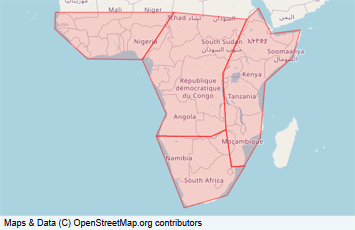
Tropical Africa, widespread


Bolbitis heudelotii (Bory ex FÉE) Alston, or African water fern, is widely distributed in the African tropics. There it grows attached to rocks or driftwood with its roots, in spray zones and inundation areas of rapidly flowing rivers and rivulets. In West Afrika it is often found in the same habitats as Anubias barteri varieties.
Very much like Java fern (Microsorum pteropus) and Anubias, Bolbitis heudelotii possesses a creeping rhizome, on which the leaves and roots grow. Its submersed leaves are single to double pinnate, transparent and bottle-green, whereas the emersed leaves are single pinnate, of a matte green, and rather hard. The entire plant is brittle.
There seem to be several forms of B. heudelotii in cultivation, which differ a bit even when kept under the same conditions.
This fern is a slow grower (every 1 to 2 months a new leaf will form), and in the aquarium it develops best if attached to rocks or driftwood to which it will adhere with its fine yet rather stable roots. Like the rhizomes of Microsorum pteropus and those of Anubias plants, those of B. heudelotii should not be covered by substrate to prevent them from rotting.
A place with a strong current close to the filter outlet and the addition of CO2 are recommendable to further the growth of Bolbitis heudelotii. Soft, slightly acidic water is optimal.
This fern is easily propagated by parting its rhizome. The rhizome pieces should at least have three leaves. Very rarely, young plants may form on old leaves.
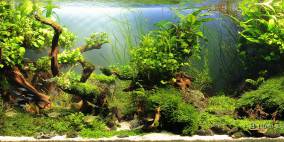
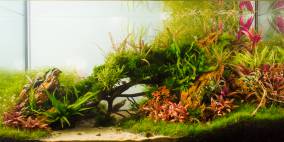
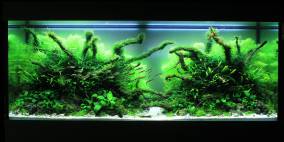
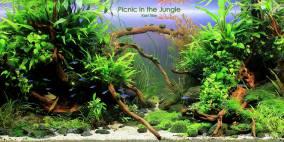
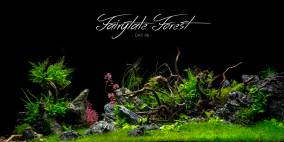
The pinnate, dark green, transparent leaves make this plant a beautiful addition to almost any aquarium layout. Of all the aquatic ferns cultivated in the hobby, Bolbitis heudelotii is probably the one that corresponds best with the image everybody has of a fern. It is most beautiful in the middleground of a tank layout. Together with driftwood and mosses, dense groups of African water fern can evoke the sense of a primeval jungle waterscape.
In the aquarium this fern develops best when it is tied onto stones or wood or inserted into the gaps of the hardscape, where it attaches itself with its fine but quite firm roots. As is also recommended for Microsorum pteropus and Anubias species, the rhizomes should not be buried in the substrate, as they could otherwise rot.
Bolbitis heudelotii is an easy-to-cultivate, adaptable plant that also copes with medium carbonate hardness and low light, but a spot with strong current, medium light intensity, rather soft, slightly acidic water, CO2 addition and macro- and micronutrient fertilisation via the water column considerably promote growth. Although this fern is generally regarded as slow-growing (a new leaf roughly every 1-2 months), this depends very much on the cultivation conditions. Under suitable conditions the growth rate should rather be classified as “medium” and also increases with the age and size of the connected plant mass. It may become necessary to keep a lush Bolbitis bush in check by regularly cutting off leaves and trimming back the rhizomes.
B. heudelotii can easily be propagated by dividing the rhizome. The rhizome pieces should have at least 3 leaves. Rarely, young plants also develop on older leaves.
The pinnate, dark green, transparent leaves make this plant a very beautiful sight in the aquarium. Of all the fern species cultivated in aquariums so far, Bolbitis heudelotii in its appearance probably corresponds most closely to what people generally imagine a fern to be. It shows to best effect above all in the midground of the aquarium. Together with driftwood and mosses, dense stands of Congo fern can convey a primeval, jungle-like impression.
<a href="https://www.flowgrow.de/db/aquaticplants/bolbitis-heudelotii" target="_blank"><img alt="Bolbitis heudelotii" title="Bolbitis heudelotii" src="https://www.flowgrow.de/db/widget/aquaticplants/bolbitis-heudelotii" /></a>
[url=https://www.flowgrow.de/db/aquaticplants/bolbitis-heudelotii][img]https://www.flowgrow.de/db/widget/aquaticplants/bolbitis-heudelotii[/img][/url]
[widget=aquaticplants/bolbitis-heudelotii]Bolbitis heudelotii[/widget]