


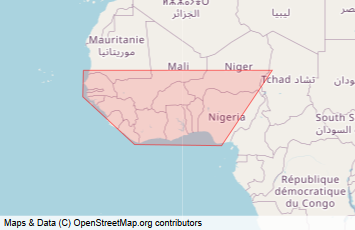
 Range and localities [?]:
Guinea, Sierra Leone, Liberia, Ivory Coast, Togo, Cameroon


As the name already suggests, Anubias gigantea is one of the large spearleaf species. The giant spearleaf is distributed in tropical West Africa and grows there as a semi-aquatic plant on river banks or in the river bed; the sites are mostly rocky.
This Anubias species is known in the aquarium hobby at least by name, but the name Anubias gigantea is also wrongly used in the trade for the similar-looking A. hastifolia. It may even be questionable whether true A. gigantea can be obtained at all in the aquatic plant trade.
According to Kasselmann (2010), this species is only moderately adapted to life under water, only conditionally suitable for aquariums, recommended mainly as a marsh plant for large paludariums because of its size, and usually needs a long time to acclimatise.
According to Kasselmann (2010), there are three different forms of A. gigantea in cultivation.
The giant spearleaf forms creeping rhizomes 1-3 cm thick. The petioles are somewhat shorter than to 2 1/2 times as long as the leaf blades and can grow up to 83 cm long. The leaf blades are hastately lobed, sometimes almost three-parted. The middle lobe is ovate or lanceolate, 13 to 30 cm long, two to four times as long as wide. The side lobes are 9 to 28 cm long and 3 to 10 cm wide.
The inflorescence stalk (peduncle) is somewhat shorter than the petioles. The inflorescence is very similar to that of Anubias afzelii. According to Crusio (1979), A. afzelii and A. gigantea are closely related and differ from each other mainly in leaf shape. A. gigantea has similar leaves to A. hastifolia and A. pynaertii and can be distinguished from these species mainly by floral characters.
- To be continued -
<a href="https://www.flowgrow.de/db/aquaticplants/anubias-gigantea" target="_blank"><img alt="Anubias gigantea" title="Anubias gigantea" src="https://www.flowgrow.de/db/widget/aquaticplants/anubias-gigantea" /></a>
[url=https://www.flowgrow.de/db/aquaticplants/anubias-gigantea][img]https://www.flowgrow.de/db/widget/aquaticplants/anubias-gigantea[/img][/url]
[widget=aquaticplants/anubias-gigantea]Anubias gigantea[/widget]

